Geomechanics: Drucker-Prager strip footing
This example combines two geomechanics building blocks into one nonlinear boundary-value problem: TensorMesh’s public Drucker-Prager material model and the elastic strip-footing setup. A rectangular soil block is loaded by a centered strip footing, the footing pressure is ramped in load steps, and the per-quadrature Drucker-Prager history is committed after each converged step.
The constitutive model is the built-in
DruckerPragerPlasticity assembler, configured with
a FrictionalMaterial.
TensorMesh keeps the internal solid-mechanics convention stress tension-positive.
For geomechanics reporting, settlement is shown positive downward,
This is a compact educational example, not a foundation-design method.
Problem
The model is a two-dimensional plane-strain-style soil block with unit out-of-plane thickness. The constitutive model is small-strain, associated Drucker-Prager plasticity with linear isotropic hardening, written internally with the tension-positive yield function
Boundary conditions
The example reuses the elastic footing roller setup:
bottom boundary: vertical displacement fixed,
u_y = 0;left and right boundaries: horizontal displacement fixed,
u_x = 0;top boundary: free except for the loaded footing patch.
The footing pressure is lumped over the top-surface nodes inside the footing patch.
Solver
Because the problem is now path-dependent, it is solved by nonlinear energy
minimization with load stepping. At each load step the total potential energy
internal - external is minimized over the free displacement DOFs with
L-BFGS. The example follows the same per-quadrature history lifecycle as the
drucker_prager_triaxial example:
per-quadrature history variables are stored in
self.history[etype];previous-step
eps_pandalphaare passed throughelement_data;update_state(u)is called after each converged load step undertorch.no_grad().
Sanity checks
The script reports the final footing settlement, the maximum settlement, the maximum and mean committed plastic history, and the plastic centroid.
The associated test checks that the footing settles downward, that the committed plastic history and settlement grow monotonically with load, that the plastic zone localizes under the footing, that a low-load / high-cohesion case stays essentially elastic and matches the elastic footing settlement, and that a higher-cohesion soil develops less plasticity.
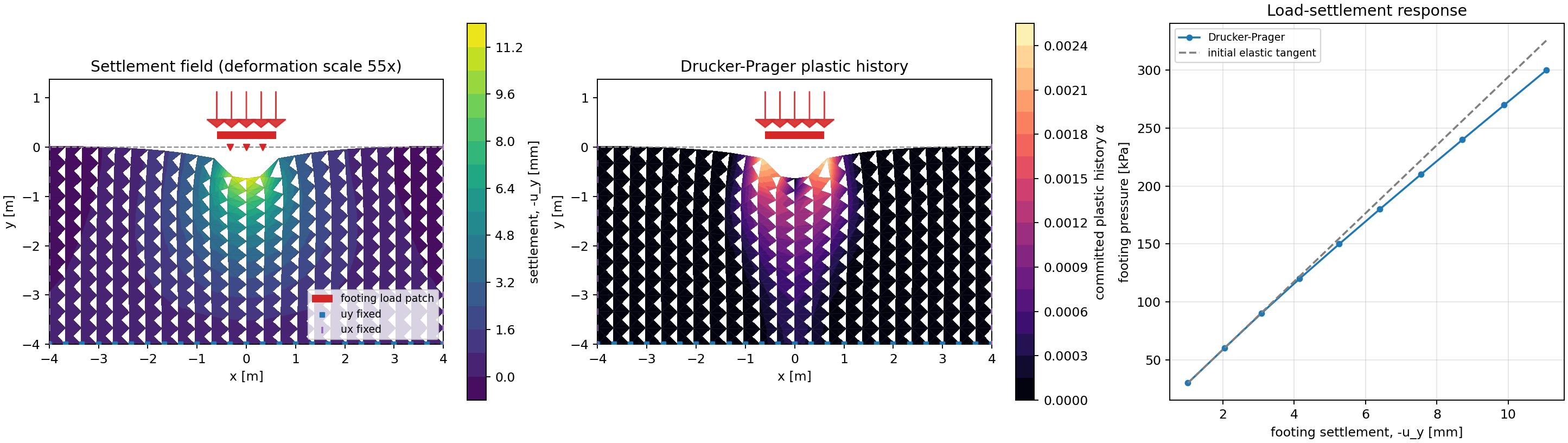
Fig. 58 Output of drucker_prager_footing.py. The left panel shows the
deformed soil mesh colored by settlement -u_y. The middle panel shows
the committed Drucker-Prager plastic history variable, which develops
beneath the footing. The right panel shows the load-settlement curve,
including nonlinear growth as plasticity accumulates. Deformations are
exaggerated for visibility.
Running it
cd examples/solid/geomechanics/drucker_prager_footing
python drucker_prager_footing.py
For a fast numerical-only run without writing the plot:
python drucker_prager_footing.py --no-plot --steps 6 --chara-length 0.60
Core implementation
The load-stepped nonlinear solver is the heart of the example. It uses the
built-in DruckerPragerPlasticity assembler’s
energy, element_data_from_history and update_state methods.
def solve_drucker_prager_footing(
    problem: FootingProblem,
    material: FrictionalMaterial,
    n_steps: int = 10,
    dtype: torch.dtype = torch.float64,
    device: str | torch.device = "cpu",
    lbfgs_max_iter: int = 50,
) -> Dict[str, Any]:
    """Solve the footing problem with Drucker-Prager plasticity and load stepping.

    The total potential energy ``internal - external`` is minimized over the free
    displacement DOFs with L-BFGS at each load step.  After each converged step
    the per-quadrature Drucker-Prager history is committed with ``update_state``.
    """
    device = torch.device(device)
    mesh = build_mesh(problem, dtype=dtype, device=device)
    dp = DruckerPragerPlasticity.from_mesh(mesh, material=material)

    dim = mesh.dim
    n_points = mesh.n_points
    n_dof = n_points * dim

    fixed = make_boundary_mask(mesh, problem)
    rhs_full, loaded_nodes, total_vertical_load = make_load_vector(mesh, problem)
    rhs_full_flat = rhs_full.flatten()

    free_flat = (~fixed).flatten()
    free_idx = torch.where(free_flat)[0]
    base_zeros = torch.zeros(n_dof, dtype=dtype, device=device)

    free_u = torch.zeros(free_idx.numel(), dtype=dtype, device=device, requires_grad=True)

    def recover_full(free_values: torch.Tensor) -> torch.Tensor:
        """Scatter the free DOFs into a full [n_points, dim] displacement field."""
        u_flat = base_zeros.index_add(0, free_idx, free_values)
        return u_flat.reshape(n_points, dim)

    load_factors: List[float] = []
    pressures_kpa: List[float] = []
    footing_settlements: List[float] = []
    max_settlements: List[float] = []
    max_alphas: List[float] = []
    mean_alphas: List[float] = []

    for step in range(1, n_steps + 1):
        load_factor = step / n_steps
        f_ext_flat = load_factor * rhs_full_flat

        optimizer = torch.optim.LBFGS(
            [free_u],
            max_iter=lbfgs_max_iter,
            tolerance_grad=1.0e-10,
            tolerance_change=1.0e-14,
            history_size=50,
            line_search_fn="strong_wolfe",
        )

        def closure() -> torch.Tensor:
            optimizer.zero_grad()
            u_full = recover_full(free_u)
            internal = dp.energy(
                point_data={"displacement": u_full},
                element_data=dp.element_data_from_history(),
            )
            external = torch.dot(f_ext_flat, u_full.flatten())
            loss = internal - external
            loss.backward()
            return loss

        optimizer.step(closure)

        with torch.no_grad():
            u_full = recover_full(free_u)
            dp.update_state(u_full)

            settlement = -u_full[:, 1]
            load_factors.append(float(load_factor))
            pressures_kpa.append(float(load_factor * problem.footing_pressure / 1.0e3))
            footing_settlements.append(float(settlement[loaded_nodes].mean()))
            max_settlements.append(float(settlement.max()))
            max_alphas.append(float(dp.max_alpha()))
            mean_alphas.append(float(dp.mean_alpha()))

    with torch.no_grad():
        u_final = recover_full(free_u).detach()

    return {
        "mesh": mesh,
        "dp": dp,
        "u": u_final,
        "fixed": fixed,
        "loaded_nodes": loaded_nodes,
        "total_vertical_load_N_per_m": total_vertical_load,
        "load_factors": load_factors,
        "pressures_kpa": pressures_kpa,
        "footing_settlements_m": footing_settlements,
        "max_settlements_m": max_settlements,
        "max_alphas": max_alphas,
        "mean_alphas": mean_alphas,
        "n_nodes": int(n_points),
        "n_steps": int(n_steps),
    }
What’s next
A natural follow-up would be to add non-associated flow and pore-pressure coupling to the public Drucker-Prager model, or to reuse this footing geometry with other built-in geomechanics materials as they are added.