Geomechanics: Drucker-Prager triaxial compression
This example introduces a small geomechanics application inside the solid-mechanics
example family. It uses TensorMesh’s public Drucker-Prager API — the
DruckerPragerPlasticity assembler, the
FrictionalMaterial container, and the constitutive
primitive drucker_prager_yield_value() — to drive a
pressure-dependent soil or weak-rock material through a simple triaxial-compression
strain path.
The goal is deliberately modest: demonstrate TensorMesh conventions for
geomechanics on a minimal driver. The example script lives in
examples/solid/geomechanics/drucker_prager_triaxial/drucker_prager_triaxial.py.
Problem
The model is small-strain, associated Drucker-Prager plasticity with linear isotropic hardening. TensorMesh keeps the internal solid-mechanics convention stress tension-positive. For geomechanics reporting, the script prints axial stress and mean pressure as compression-positive quantities.
The yield function is written internally as
where
Because compression gives negative I1 in the tension-positive convention,
higher confinement lowers f and delays yielding.
History variables
The built-in assembler follows the same lifecycle as the J2 plasticity model:
per-quadrature history variables are stored in
model.history[etype];previous-step
eps_pandalphaare passed throughelement_data(viamodel.element_data_from_history());update_state(u)is called after each converged load step undertorch.no_grad().
Sanity check
Two confinement levels are run:
p0 = 0 kPa;p0 = 100 kPa.
The script checks that the higher-confinement case reaches the elastic trial yield surface later and that the committed plastic history variable is monotonic.
Running it
cd examples/solid/geomechanics/drucker_prager_triaxial
python drucker_prager_triaxial.py
For a fast numerical-only run without writing the plot:
python drucker_prager_triaxial.py --no-plot --steps 16
The default run writes drucker_prager_triaxial.png with axial stress and
plastic-history curves.
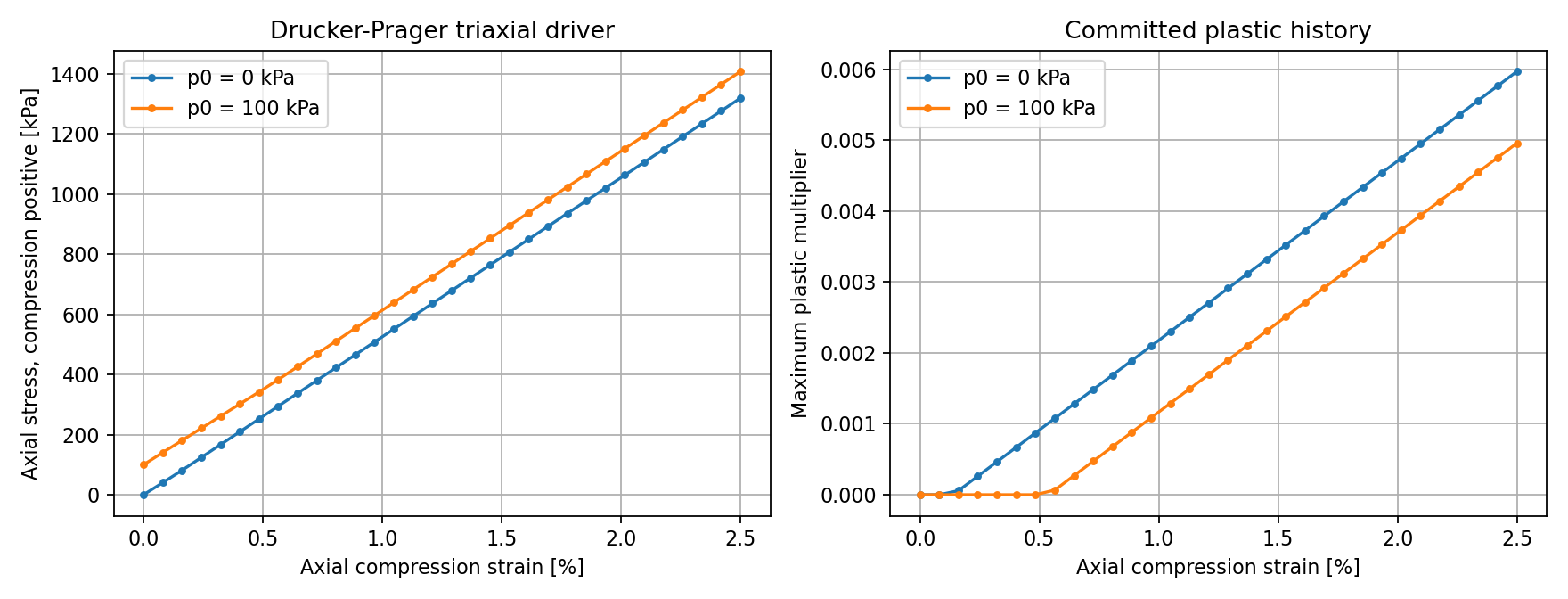
Fig. 64 Output of drucker_prager_triaxial.py. The left panel shows the
compression-positive axial stress response; the right panel shows the
committed plastic history variable. The higher-confinement case yields
later, matching the pressure-dependent Drucker-Prager sanity check.
Core implementation
The driver builds a FrictionalMaterial, assembles
the built-in DruckerPragerPlasticity model, and
steps the strain path while committing history with update_state:
def run_case(
    confinement_pressure: float,
    material: FrictionalMaterial,
    n_steps: int = 32,
    axial_strain_final: float = -0.025,
    chara_length: float = 0.75,
) -> Dict[str, List[float]]:
    """Run one displacement-controlled triaxial-compression case."""
    dtype = torch.float64
    device = torch.device("cpu")

    mesh = gen_cube(
        left=0.0,
        right=1.0,
        bottom=0.0,
        top=1.0,
        front=0.0,
        back=1.0,
        chara_length=chara_length,
    )
    mesh.points = mesh.points.to(device=device, dtype=dtype)

    model = DruckerPragerPlasticity.from_mesh(mesh, material=material)
    points = mesh.points

    result: Dict[str, List[float]] = {
        "axial_strain": [],
        "axial_stress_compression_kpa": [],
        "mean_pressure_compression_kpa": [],
        "alpha_max": [],
        "elastic_trial_f_kpa": [],
    }

    for axial_strain_value in torch.linspace(0.0, axial_strain_final, n_steps, device=device, dtype=dtype):
        eps_diag = triaxial_strain_path(axial_strain_value, confinement_pressure, material)
        u = affine_displacement(points, eps_diag).detach().clone().requires_grad_(True)

        energy = model.energy(
            point_data={"displacement": u},
            element_data=model.element_data_from_history(),
        )
        # Calling backward confirms the potential is differentiable, even though
        # this affine driver has no unconstrained degrees of freedom to optimize.
        if energy.requires_grad:
            energy.backward()

        model.update_state(u)
        sigma = model.mean_stress(u)
        p_comp = -sigma.trace() / 3.0
        sigma_axial_comp = -sigma[2, 2]
        f_elastic = elastic_trial_yield_value(eps_diag, material)

        result["axial_strain"].append(float(-axial_strain_value))
        result["axial_stress_compression_kpa"].append(float(sigma_axial_comp / 1.0e3))
        result["mean_pressure_compression_kpa"].append(float(p_comp / 1.0e3))
        result["alpha_max"].append(float(model.max_alpha()))
        result["elastic_trial_f_kpa"].append(float(f_elastic / 1.0e3))

    return result